| Author |
Message |
|
Jim Phillips (brainfiller)
|
Post subject: Arc Flash Warning Label Data  Posted: Posted: Sun Sep 19, 2010 2:37 pm |
|
| Plasma Level |
 |
Joined: Mon Sep 17, 2007 5:00 pm
Posts: 1737
Location: Scottsdale, Arizona
|
|
What information to you include on the arc flash warning labels?
_________________
Jim Phillips, P.E.
Brainfiller.com
|
|
| Top |
|
 |
|
Jim Pollard
|
Post subject: Posted: Wed Sep 22, 2010 1:09 pm |
|
Joined: Fri Jul 31, 2009 5:13 am
Posts: 31
|
|
Great poll question!
I love asking the following question to companies in the business of labeling equipment; "Why should you NOT include PPE Category / Level on a detailed arc flash hazard analysis label?"
I personally can't wait for clarification on a proper detailed label to be provided in our 2012 edition of CSA Z462!!
|
|
| Top |
|
|
|
JBD
|
Post subject: Posted: Wed Sep 22, 2010 2:13 pm |
|
Joined: Mon Jan 18, 2010 11:35 am
Posts: 614
Location: Wisconsin
|
Jim Pollard wrote: I love asking the following question to companies in the business of labeling equipment; "Why should you NOT include PPE Category / Level on a detailed arc flash hazard analysis label?"
Why would I want to dress in HRC=3 (25 cal/cm²) clothing when the incident energy level is only 9 cal/cm², if all of my PPE is rated for a minimum of 11 cal/cm²?
|
|
| Top |
|
|
|
Jim Pollard
|
Post subject: Posted: Thu Sep 23, 2010 8:31 am |
|
Joined: Fri Jul 31, 2009 5:13 am
Posts: 31
|
JBD wrote: Why would I want to dress in HRC=3 (25 cal/cm²) clothing when the incident energy level is only 9 cal/cm², if all of my PPE is rated for a minimum of 11 cal/cm²?
Thanks JBD, great example. Should you choose to follow NFPA 70E-2009, Article 130.3, the arc flash hazard analysis shall determine the selection of your PPE. Furthermore, 130.2(B) explains that your arc rated FR PPE used shall be selected based on the incident energy exposure associated with the specific task.
My point was more towards the FACT that Hazard/Risk Categories shall never be reverse engineered as per the NFPA 70E Technical Committee. Therefore, using calculated incident energy exposures from an incident energy analysis should never directly relate to any Hazard/Risk Category. Both 130.2(B) PPE selection methods ((1)Incident Energy Analysis and (2)Hazard/Risk Categories) should be kept separate and never confused as being the same.
|
|
| Top |
|
|
|
JBD
|
Post subject: Posted: Thu Sep 23, 2010 12:13 pm |
|
Joined: Mon Jan 18, 2010 11:35 am
Posts: 614
Location: Wisconsin
|
Jim Pollard wrote: My point was more towards the FACT that Hazard/Risk Categories shall never be reverse engineered as per the NFPA 70E Technical Committee. Therefore, using calculated incident energy exposures from an incident energy analysis should never directly relate to any Hazard/Risk Category. Both 130.2(B) PPE selection methods ((1)Incident Energy Analysis and (2)Hazard/Risk Categories) should be kept separate and never confused as being the same.
I agree the Hazard Risk Categories are not to be reverse engineered.
However, there is a big difference between reverse engineering to select PPE and deciding on what task can be performed.
Part of me believes, that after calculations have been performed everyone should tear table 130.7(C)(9) out of their 70E books.
But, I see nothing wrong with a company policy that rounds up calculated, per 130.3(B)(1), AFIE values (i.e. 9.1 is rounded up to 10). I also see nothing wrong with a policy for grouping AFIE values into specific ranges in order to select PPE (i.e. all employees shall dress in a minimum of 11 cal/cm² PPE for all locations with incident energy values up to and including 8 cal/cm²). Finally there should be no problem with a policy that creates a table outlining what PPE is actually required to meet each of the company's specific PPE ranges. So where is the harm if the company's tables happen to look similar, if not identical, to Tables 130.7(C)11 and then 130.7(C)(10)?
|
|
| Top |
|
|
|
BCR_1962
|
Post subject: Posted: Fri Sep 24, 2010 11:41 am |
|
Joined: Tue Feb 16, 2010 7:59 am
Posts: 21
Location: Minneapolis, MN
|
|
Label information can create quite a bit of discussion/controversy. With the exception of 1.2 Cal/cm^2, the threshold for a second degree burn and 40+ Cal where PPE is not possible, the HRC categories and their deliniations are quite arbitrary but perfectly acceptable. However, there is no reason you can't put the delinations where you want. You can call them HRC Categories or name them after football teams. You can have three levels of PPE at your facility or seventeen. What matters is that you have enough PPE to protect yourself from the incident energy. Compliance with NFPA 70E is not the end of the road, not getting burned is. We use the HRC categories because they are perfectly acceptable but I see no reason why you have to use them or couldn't define your own.
(Thanks JBD and Jim, I'm not feeling like such a lone wolf after all)
Bob Ragsdale P.E.
|
|
| Top |
|
|
|
Ex twidget
|
Post subject: Posted: Mon Oct 11, 2010 4:08 pm |
|
Joined: Mon Jan 26, 2009 5:00 pm
Posts: 46
Location: Midwest
|
|
| Top |
|
|
|
Jim Phillips (brainfiller)
|
Post subject: Posted: Mon Oct 11, 2010 4:46 pm |
|
| Plasma Level |
|
Joined: Mon Sep 17, 2007 5:00 pm
Posts: 1737
Location: Scottsdale, Arizona
|
Ex twidget wrote: Here is an NFPA article that discusses HRC and Incident energy on a label. http://www.nfpa.org/publicColumn.asp?categoryID=2073&itemID=48396&src=NFPAJournalThe article implies HRC and IE aren't intended to be on the label together. HRC's are not being permitted with IE is more of a techinical point since HR refers to a risk. No one excludes using just "categories" or levels as many have begun to call it without using the term HR. You don't need to have categories or use levels but there should be nothing to prohibit it if you do. It is quite illogical and I have posted quite a bit about the debate that has been going on.
Categories were in fact used with IE for the development of IEEE 1584's Cf (calculation factor). I brought this up with NFPA which proves you CAN correlate the two so at the next IEEE meeting an NFPA member suggested we revise 1584 and remove the reference to Cf. (a.k.a hide the evidence that their position is incorrect)
I talked with the past chairman of NPFA who retired a few years ago and was a major force in the industry and with 70E. He agrees there is nothing to prohibit categories and IE and was surprised by it all.
There were a few changes proposed for 2012 to change IE OR Category to IE and/or category. I hear the intent was accepted in principal but I don't know how it will ulitmatley play out.
Thanks for the link!
_________________
Jim Phillips, P.E.
Brainfiller.com
|
|
| Top |
|
|
|
ChevsMark
|
Post subject: Posted: Thu Oct 14, 2010 7:46 am |
|
Joined: Thu Jan 07, 2010 6:42 am
Posts: 35
Location: Bowling Green, KY
|
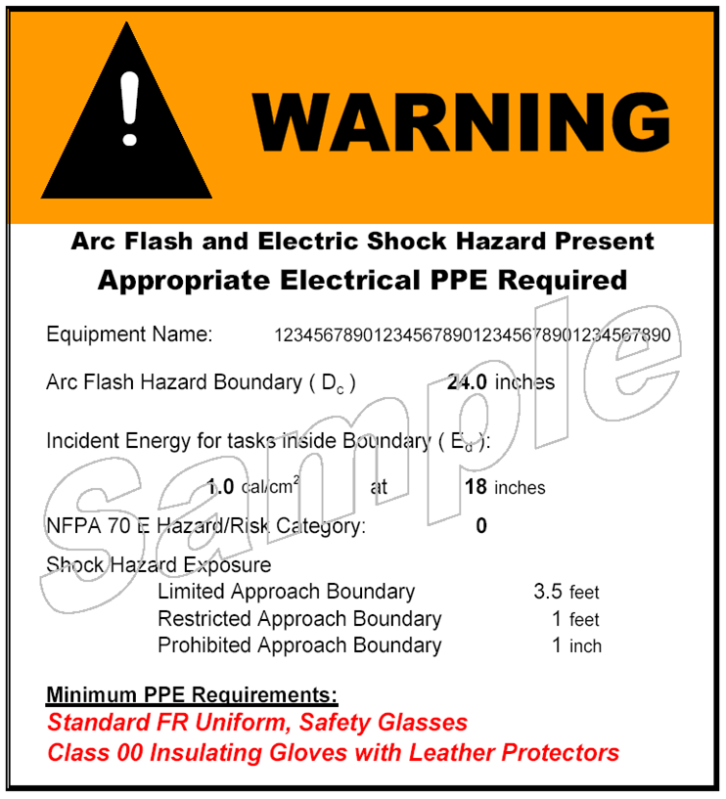
[font="Comic Sans MS"][SIZE="3"]This is what I modeled ours after. In addition I added a line to include feed information (bus ID/voltage and ampacity.[/size][/font]
|
|
| Top |
|
|
|
jghrist
|
Post subject: Posted: Fri Oct 15, 2010 10:09 am |
|
Joined: Wed Jun 04, 2008 9:17 am
Posts: 428
Location: Spartanburg, South Carolina
|
ChevsMark wrote: [font="Comic Sans MS"][SIZE="3"]This is what I modeled ours after. In addition I added a line to include feed information (bus ID/voltage and ampacity.[/size][/font] I realize that it's just an example, but how can the incident energy be 1.0 cal/cm² at 18" when the arc hazard boundary is 24". An arc hazard boundary at 24" would mean that the incident energy was 1.2 cal/cm² at 24", but it should be lower at 24" than at 18".
|
|
| Top |
|
|
|
grapejape
|
Post subject: Posted: Tue Nov 02, 2010 7:15 am |
|
Joined: Tue Jun 02, 2009 7:54 pm
Posts: 10
|
|
After reading this and the linked NFPA article, specifically this part
Where an incident energy level is calculated, it is not intended that the calculated number be converted into a hazard/risk category using the minimum arc ratings for PPE from Table 130.7(C)(11). This is like mixing apples and oranges. NFPA 70E provides two separate methods by which to select PPE, and they should be used independently. One way is to determine a caloric value by calculating incident energy, and the other is to use the hazard/risk categories in the tables permitted by Section 130.3, Exception No. 2—thus the requirement for the label to specify either the available incident energy or the required level of PPE.
I have a question. We, like most other facilities I have seen, have Arc Flash labels that list the incident energy along with an HRC designation. Granted, not all HRC 2 equipment has the same avaliable energy - but if it is between 4cal/cm2 and 8 cal/cm2 then it gets a HRC2 label.
If one were to not use this method of grouping and only list the incident energy on the label - how would employees know when to select other PPE like face shields or arc flash hoods? We hand out a card to all qualified employees that lists the required PPE for each category so that when they see a "2" - they know what is required.
- Jason
|
|
| Top |
|
|
|
Vincent B.
|
Post subject: Posted: Tue Nov 02, 2010 7:28 am |
|
Joined: Tue Feb 24, 2009 7:05 am
Posts: 252
|
|
Face shields and hoods have a cal/cm^2 rating labeled on them, in the same way that PPE garments have one. Choose PPE having a higher rating than the hazard posted on the label (in cal/cm^2).
|
|
| Top |
|
|
|
Jim Phillips (brainfiller)
|
Post subject: Posted: Tue Nov 02, 2010 9:58 am |
|
| Plasma Level |
|
Joined: Mon Sep 17, 2007 5:00 pm
Posts: 1737
Location: Scottsdale, Arizona
|
grapejape wrote: After reading this and the linked NFPA article, specifically this part
Where an incident energy level is calculated, it is not intended that the calculated number be converted into a hazard/risk category using the minimum arc ratings for PPE from Table 130.7(C)(11). This is like mixing apples and oranges. NFPA 70E provides two separate methods by which to select PPE, and they should be used independently. One way is to determine a caloric value by calculating incident energy, and the other is to use the hazard/risk categories in the tables permitted by Section 130.3, Exception No. 2—thus the requirement for the label to specify either the available incident energy or the required level of PPE.
I have a question. We, like most other facilities I have seen, have Arc Flash labels that list the incident energy along with an HRC designation. Granted, not all HRC 2 equipment has the same avaliable energy - but if it is between 4cal/cm2 and 8 cal/cm2 then it gets a HRC2 label.
If one were to not use this method of grouping and only list the incident energy on the label - how would employees know when to select other PPE like face shields or arc flash hoods? We hand out a card to all qualified employees that lists the required PPE for each category so that when they see a "2" - they know what is required.
- Jason
You can find this issue and the heated debate all over the forum. Here is the main one >> [url="http://www.arcflashforum.com/showthread.php?t=655"][THREAD][/url] I still stand by the logic, if Cat 2 (not HRC but Category only) is 8 cal minimum PPE then there is nothing wrong with requiring Cat 2 PPE when you calculated something less than 8 cal. Although all you need is PPE that exceeds the incident energy. I went as far as to talk with the former Chairman of NFPA and one of the most respected and original pioneers of all this and he also agreed. There was also a survey about this conducted a while go which is part of the link above.
_________________
Jim Phillips, P.E.
Brainfiller.com
|
|
| Top |
|
|
|
grapejape
|
Post subject: Posted: Tue Nov 02, 2010 10:03 am |
|
Joined: Tue Jun 02, 2009 7:54 pm
Posts: 10
|
|
Thanks Jim.
The Arc Flash labeling is very new to the employees here. They all seemed to understand and appreciate the simplistic numerical system.
We even went as far to simplify the avaliable PPE to 0, 2, or 4 in order to eliminate confusion, using the "simplified approach" recommended in the NFPA70e appendix. While I understand the logic of listing only the incident energy on the labels, I think that employees with different levels of understanding would likely mis-apply this.
Enjoying the forum.
- Jason
|
|
| Top |
|
|
|
Gary B
|
Post subject: Posted: Wed Dec 29, 2010 9:19 pm |
|
Joined: Thu Oct 18, 2007 7:10 pm
Posts: 262
Location: NW USA
|
brainfiller wrote: HRC's are not being permitted with IE is more of a techinical point since HR refers to a risk. No one excludes using just "categories" or levels as many have begun to call it without using the term HR. You don't need to have categories or use levels but there should be nothing to prohibit it if you do. It is quite illogical and I have posted quite a bit about the debate that has been going on.
Categories were in fact used with IE for the development of IEEE 1584's Cf (calculation factor). I brought this up with NFPA which proves you CAN correlate the two so at the next IEEE meeting an NFPA member suggested we revise 1584 and remove the reference to Cf. (a.k.a hide the evidence that their position is incorrect)
I talked with the past chairman of NPFA who retired a few years ago and was a major force in the industry and with 70E. He agrees there is nothing to prohibit categories and IE and was surprised by it all.
There were a few changes proposed for 2012 to change IE OR Category to IE and/or category. I hear the intent was accepted in principal but I don't know how it will ulitmatley play out.
Thanks for the link!
Thanks for the link to the other thread Jim.
The labels we install have the calculated exposure in Cal/cm2 at the given working distance. That makes a good QA QC check as we install the labels and verify this makes some sense (we've had labels printed with too low of an exposure based on downstream of main device, that I have caught by this method).
We also include what Risk Category this includes as the PPE assignment is based on PPE. That is done as a courtesy to the workers.
|
|
| Top |
|
|
|
Gary B
|
Post subject: Posted: Wed Dec 29, 2010 9:25 pm |
|
Joined: Thu Oct 18, 2007 7:10 pm
Posts: 262
Location: NW USA
|
Jim Pollard wrote: Great poll question!
I love asking the following question to companies in the business of labeling equipment; "Why should you NOT include PPE Category / Level on a detailed arc flash hazard analysis label?"
I personally can't wait for clarification on a proper detailed label to be provided in our 2012 edition of CSA Z462!!
Seems like a silly question, when in fact 99 percent of all labels installed do include a Risk Category that prescribes PPE. Perhaps I am missing your point or this was not a sincere post?
|
|
| Top |
|
|
 
|
Page 1 of 1
|
[ 16 posts ] |
|
|
You cannot post new topics in this forum
You cannot reply to topics in this forum
You cannot edit your posts in this forum
You cannot delete your posts in this forum
You cannot post attachments in this forum
|
|


